The Lifespan of Dental Restorations

Table Of Content

Single Post Thumbnail

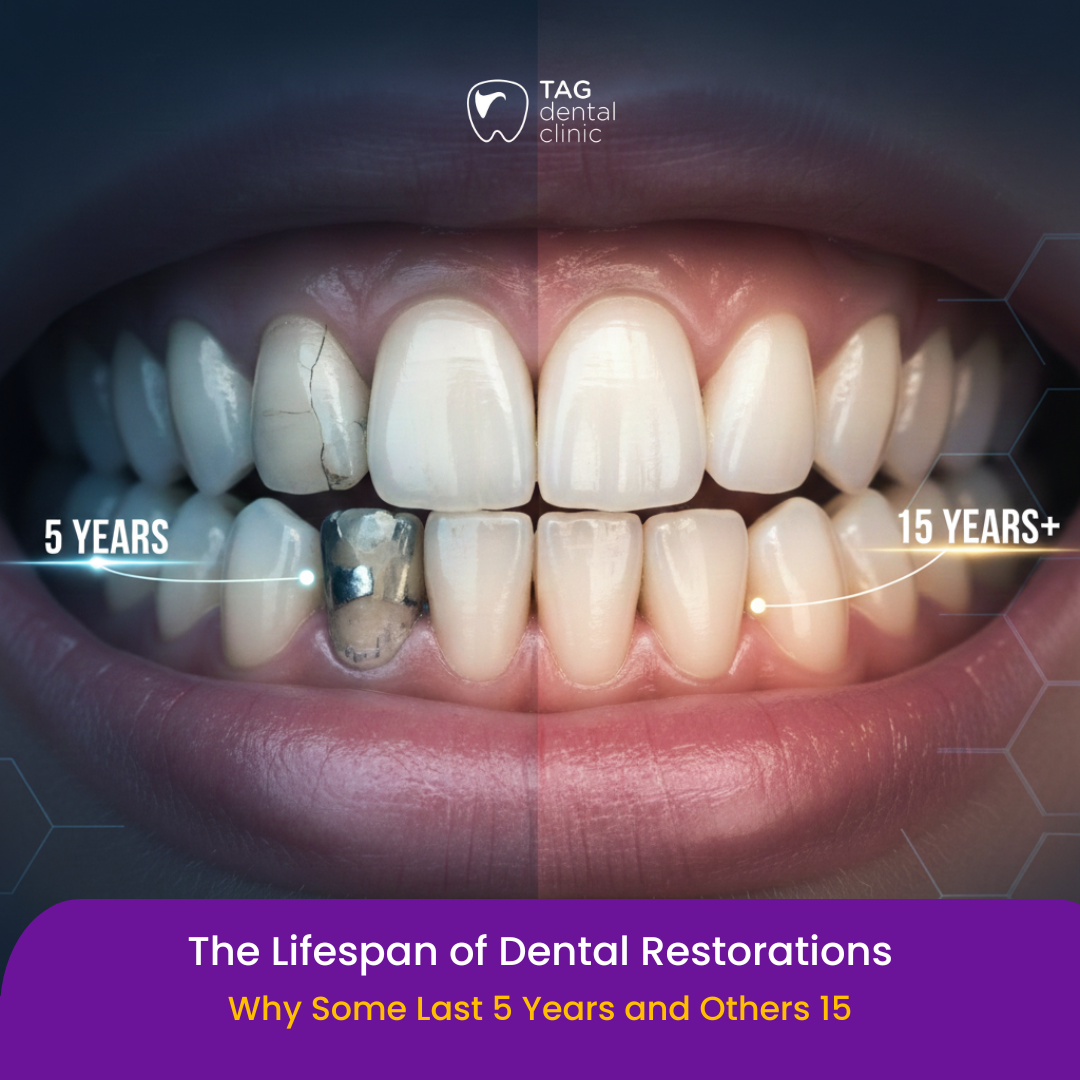
Why Some Dental Restorations Last 5 Years and Others 15

Phone: +60 11-1111 0660

Address: Suite 20-17, Austin 18 Versatile Business Suites, Jalan Austin Perdana 3, Taman Austin Perdana, 81100 Johor Bahru, Johor Darul Ta'zim, Malaysia Location Map

How long do dental restorations last? Most dental restorations, such as crowns, bridges, and veneers, typically last between 7 and 15 years. The difference between a restoration that fails at year 5 versus year 15 is determined by three key factors: the precision of the initial placement, the patient's daily hygiene habits (specifically brushing 3 times a day), and regular professional reviews to catch microscopic wear before it leads to failure.

Understanding the "5 vs. 15" Year Gap

At TAG Dental Clinic in Austin 18, JB, we view a dental restoration not as a "fix," but as a long-term investment in your health. Here is what determines the longevity of your dental work.

1. Material Precision vs. Biological Reality

While we use high-tech digital 2D X-rays to ensure the foundation of your tooth is healthy before placement, no material is 100% indestructible.

  • Material Limitations: Fillings and crowns are strong, but they lack the "give" of natural teeth.
  • The Power of 3: To reach that 15-year mark, we recommend brushing 3 times a day. This extra midday brush is crucial for removing the acids and bacteria that accumulate after lunch, preventing "marginal leakage"—the #1 reason restorations fail early.

2. Why Maintenance Matters as Much as Placement

A restoration is only as good as the seal between the material and your tooth.

  • No 3D X-ray? No Problem: For routine restorations, high-resolution digital 2D X-rays are often the superior choice. They provide the precise, high-contrast detail needed to check the margins of a crown or filling without the higher radiation or cost of a 3D scan, which is typically reserved for complex surgeries.
  • The TAG Sedation Approach: We understand that dental anxiety is a real barrier to maintenance. While we do not offer laughing gas (nitrous oxide), we prioritize patient safety above all. If deep sedation is required for your comfort, it is performed under the supervision of a qualified medical doctor to ensure the highest standard of care and monitoring.

15+ Frequently Asked Questions (FAQs)

1. Why do you recommend brushing 3 times a day instead of 2?

Brushing after lunch removes food debris that would otherwise sit on your restorations for 8+ hours, significantly reducing the risk of decay at the margins.

2. How long do restorations last?

Modern dental materials are designed for incredible durability. While no medical procedure is 'infinite,' high-quality restorations at TAG Dental often last 10 to 15 years or more.

3. Does TAG Dental Clinic offer laughing gas?

No. We focus on a gentle, pain-free manual technique. For patients requiring sedation, we arrange for medical doctor supervision for advanced safety.

4. Why don't you use 3D X-rays for crowns?

Digital 2D X-rays provide higher clarity for the "interface" between the tooth and the crown, which is the most important area to monitor for restoration longevity.

5. Can I eat normally with a 15-year-old crown?

Yes, but avoiding extremely hard foods (like ice or crab shells) helps ensure you reach that 15-year milestone.

6. Does a "long-lasting" restoration cost more?

Not necessarily. Longevity is more about the care after placement than the initial price tag.

7. How do I know if my filling is failing?

Common signs include sensitivity to cold, a "catch" when flossing, or a dark shadow appearing under the edges.

8. Can gum disease cause my bridge to fail?

Absolutely. If the bone and gums supporting the restoration are unhealthy, the restoration will fail regardless of its quality.

9. Is it safe to have sedation managed by a medical doctor?

Yes, this is the gold standard for safety, ensuring your vitals are monitored by a specialist while our dentists focus on your smile.

10. Do lifestyle habits like smoking affect restorations?

Yes, smoking reduces blood flow to the gums, which can weaken the foundation of your dental work.

11. How often should I have my restorations reviewed?

Every 6 months. We check for microscopic gaps that are invisible to the naked eye.

12. Can a cracked crown be repaired?

Usually, a cracked crown requires replacement to ensure the underlying tooth remains protected from bacteria.

13. What is the best material for a long-lasting crown?

Zirconia and E-max porcelain are currently the leaders for durability and aesthetics.

14. Why is Johor Bahru a good place for restorative work?

JB clinics, like TAG Dental, offer world-class materials and specialist care at a value that allows patients to afford the best long-term solutions.

15. Does coffee stain my veneers?

No. High-quality porcelain is highly glazed and non-porous, making it naturally resistant to stains from coffee, tea, or wine. Unlike natural tooth enamel, the porcelain used at TAG Dental maintains its brilliant shade and luster over time, ensuring your smile stays bright and consistent for years to come.

16. What should I do if my restoration falls out?

Keep the restoration and call us at TAG Dental immediately. Do not try to glue it back yourself, as this can trap bacteria.

Expert Tip: Trust Your Gut, But Consult a Specialist

Managing your expectations is the first step toward a healthy smile. While we can provide the best technical work in Johor Bahru, your daily routine is what keeps that work "shining brighter than ever" in 2026.

Ready to optimize your dental health for the long term? Visit us at TAG Dental Clinic, Austin 18, JB. +60 11-1111 0660