Surgical vs. Prosthetic Dentistry: Why Implant Success Is a Team Effort

Table Of Content

Single Post Thumbnail

Why Implant Success Is a Team Effort

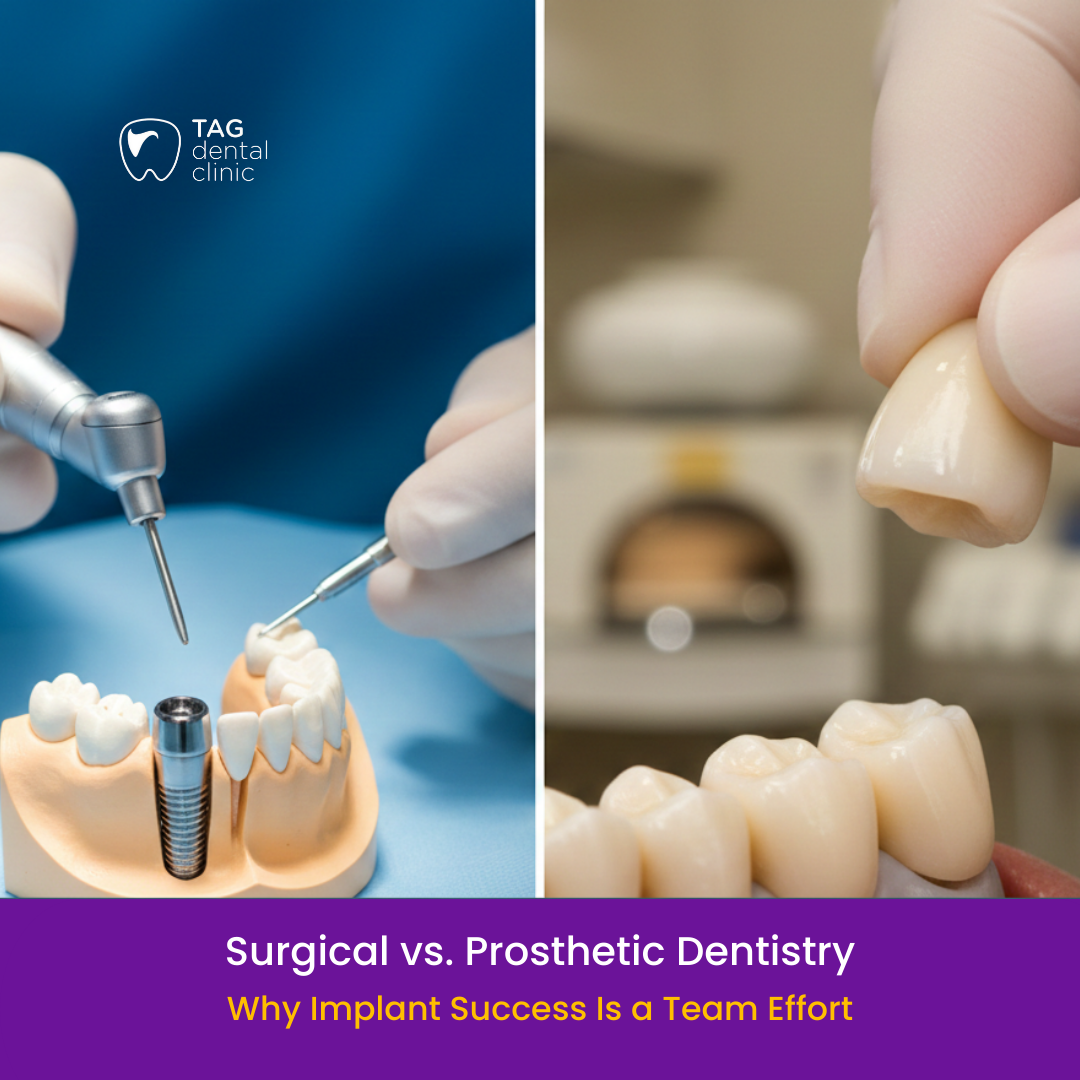
Why is dental implant success a team effort? True implant success requires a multidisciplinary approach where the restorative dentist (the architect) and the surgeon (the builder) work in sync. This "top-down" planning ensures the implant is placed in the precise position needed to support a functional, aesthetic crown. Without this coordination, even a perfectly integrated implant can result in "unrestorable" positions, food traps, or a smile that looks unnatural.

The Architecture of a Smile: Planning Before Placing

At TAG Dental Clinic in Johor Bahru, we follow a strict "Prosthetic-First" protocol. Most patients assume the surgery is the first step, but in modern implantology, the design of the tooth (the crown) happens before a single hole is drilled.

1. The Role of the Surgeon vs. Restorative Dentist

  • The Restorative Dentist (The Architect): They analyze your bite, smile line, and speech. They determine exactly where the tooth should be for you to chew comfortably.
  • The Surgeon (The Builder): They use the restorative plan to navigate the jawbone. Their job is to ensure the titanium post (the implant) integrates securely into the bone while matching the restorative "blueprint."

2. Why the Crown Comes First

If you place an implant based solely on "where the bone is" rather than "where the tooth belongs," you end up with a Malpositioned Implant.

  • Functional Issues: If the implant is too far forward or backward, the crown won't align with your bite, leading to cracked porcelain or headaches.
  • Aesthetic Disasters: Poor coordination often leads to "grey shadows" at the gum line or teeth that look too long or bulky compared to your natural ones.

3. How We Coordinate Success at TAG Malaysia JB

We believe precision doesn't require unnecessary complexity.

  • High-Resolution 2D Digital X-Rays: While some clinics push for 3D scans for every case, we utilize advanced digital 2D X-rays. This provides high-contrast clarity for the vast majority of restorative planning while minimizing radiation—keeping your safety at the forefront.
  • Medical Doctor Supervised Sedation: We do not use laughing gas (nitrous oxide). For patients who require extra comfort during the surgical phase, we bring in a qualified medical doctor to manage sedation. This ensures that the surgical team can focus 100% on the precision of the implant placement while a specialist monitors your vitals.

15+ FAQs: Understanding the Team Effort

1. Who actually performs my implant surgery?

At TAG, surgeries are performed by experts focused on surgical precision, but the final tooth is designed by our aesthetic specialists.

2. Why don't you offer laughing gas?

We believe in the highest safety standards. Laughing gas can be inconsistent; therefore, we use medical-grade IV sedation for a more controlled, safe experience.

3. Is it true I need to brush 3 times a day for my implant?

Yes! To reach a 25 year lifespan, you must brush 3 times daily. Implants are prone to "peri-implantitis" (gum disease around the post), which is easily prevented by that extra midday brush.

4. Why don't you use 3D X-rays?

3D scans are often overused. Our high-tech digital 2D X-rays provide the necessary detail for the majority of successful implant placements with significantly less radiation exposure for the patient.

5. What happens if the surgeon and restorative dentist don't talk?

You may end up with an implant that is healthy in the bone but impossible to put a crown on, or one that constantly traps food.

6. Can one dentist do both parts?

While some do, a "team approach" ensures you get a specialist’s eye for both the bone health (surgery) and the smile design (prosthetics).

7. How long is the wait between surgery and the final crown?

Usually 3 to 6 months. This allows the bone to "osseointegrate" or fuse with the implant post.

8. Will my final crown look like a "fake" tooth?

Not with prosthetic-driven planning. By designing the crown first, we ensure it emerges from the gum just like a natural tooth.

9. Is the sedation managed by the dentist?

No. At TAG, we prioritize your safety by having a medical doctor handle sedation, ensuring professional monitoring throughout the procedure.

10. Do implants ever fail?

Failures are rare (less than 2-3%) and are usually due to poor hygiene or systemic health issues like uncontrolled diabetes.

11. Does insurance cover the surgical or restorative part?

Most Malaysian dental plans cover a portion of both; we can help you with the necessary documentation.

12. Why is Johor Bahru a popular spot for implants?

Clinics like TAG in JB offer world-class materials (Zirconia/E-max) and high-level specialist care at a value that is much more accessible than in Singapore or Europe.

13. Can I get an implant if I have bone loss?

Often, yes. The surgeon can perform a bone graft to build a foundation for the "builder" to work on.

14. Does the "team effort" make the process more expensive?

Actually, it often saves money by preventing "do-overs" and complications that arise from poor initial planning.

15. How do I start the process?

It begins with a consultation where we use our digital X-rays to create your restorative blueprint.

16. What is the most important thing I can do for my implant? Brush 3 times a day.

Consistent hygiene is the only way to protect the "seal" between your gums and the new restoration.

Optimize Your Smile for 2026

Don't settle for a "one-size-fits-all" approach. Experience the precision of multidisciplinary care at TAG Dental Clinic, Austin 18, JB.

Book your restorative-driven consultation today.